Finding out that doctors “found something” in your brain can send anyone and their loved ones into a state of complete panic and distress. Still, with all the advances in medicine today, being diagnosed with a brain tumor or other diseases of the brain doesn’t mean that you should give up on life.
Since 1998, the Philippine Gamma Knife Center, a component of the Brain and Spine Institute of Cardinal Santos Medical Center (CSMC), has been a beacon of hope for thousands of patients who might have otherwise required open brain surgery.

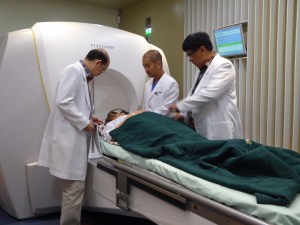
(l-r): CSMC’s Chairman of the Brain and Spine Institute and Clinical Director of the Philippine Gamma Knife Center Dr. Theodor Vesagas, neurosurgeon Dr. Levi M. Maliwat, and medical physicist Eliseo de la Cruz setting up a patient for Gamma Knife Radiosurgery.
“Gamma Knife Radiosurgery is a technique where doses of radiation are precisely delivered to targets in an affected part of the brain without damaging the surrounding normal tissue,” explained Dr. Theodor S. Vesagas, Chairman of CSMC’s Brain and Spine Institute and Clinical Director of the Philippine Gamma Knife Center.
“It is a non-invasive procedure. It doesn’t involve a scalpel so the patient will not have to suffer an incision,” Dr. Vesagas continued. “The ‘knife’ in Gamma Knife actually refers to the machine’s knife-like precision where 192 narrowly focused beams of gamma radiation converge on a tumor or target. Outside of the target, brain tissue will not receive significant doses of radiation.”
The Leksell Gamma Knife was invented by Prof. Lars Leksell, a Swedish neurosurgeon. He designed it specifically for, and to be exclusively used in the brain. It is used to treat tumors both benign (such as meningiomas and vestibular schwannomas) and malignant (such as brain metastases). The technique is also used to treat vascular conditions like arterio-venous malformations (AVMs), tangles of vessels that form abnormal connections between arteries and veins of the brain. Likewise, it is successful in the management of trigeminal neuralgia, a neurological condition that causes excruciating electric shock-like pain on one side of the face.
“Gamma Knife Radiosurgery is widely recognized as the gold standard technique of stereotactic radiosurgery,” noted Dr. Vesagas.
The procedure is a 4-step process. The first step involves attaching a frame to the patient, who will be under local anesthesia, to keep the head stable. An imaging procedure usually an MRI scan, a CT scan, or, in some cases, an angiogram—will then be performed. The images produced will help the Gamma Knife team plan out the treatment, and program the machine. Afterwards, the patient will be moved to the robotic patient treatment couch, and the treatment program will commence. Depending on factors such as the size and shape of the tumor or the type of condition, the treatment will usually take under an hour.
“It’s safe, painless, and non-invasive,” confirmed Dr. Vesagas. “We generally deliver our treatments in only a single session. Moreover, whereas after open brain surgery, the patient may need weeks to months to convalesce and recover, our patients usually go home right after Gamma Knife treatment, and may return to work a few days after.”
The Philippine Gamma Knife Center at CSMC remains the only facility of its kind in the entire Philippines. Ask your doctor if Gamma Knife radiosurgery is applicable for your diagnosis. You may also call 8725-9254 or (0920) 9469568, or send an email at info@gammaknife.com.ph, to inquire or book an appointment.